The first time I made coffee over a fire I did it by putting grounds directly into a pot of water and boiling it hard for about five minutes, because I had read somewhere that this was the authentic way. What I got was a mug of hot bitter liquid with a layer of grit at the bottom and a scum of oil on top. I drank all of it, standing up in a jacket at six in the morning, and told my brother it was great.
It was not great. But that mug started about four years of me trying every method I could carry, and I have landed somewhere I am happy with, so it is worth writing down what worked and what quietly went back in the garage.
The percolator phase
I bought a stovetop percolator because it looked right. Enamel, a glass knob on the lid, the whole thing. I wanted to be the guy with the percolator going on the coals while everybody else was still in their tents.
It made decent coffee maybe half the time. The problem is that a percolator recirculates boiling water through the grounds over and over, and the difference between good and burnt is a couple of minutes of inattention. Over a fire, where the heat is uneven and changing, I could not hold it steady. I would turn around to deal with something else, hear it bubbling harder than it had been, and know I had lost it.
Pour over, and why I stopped bothering
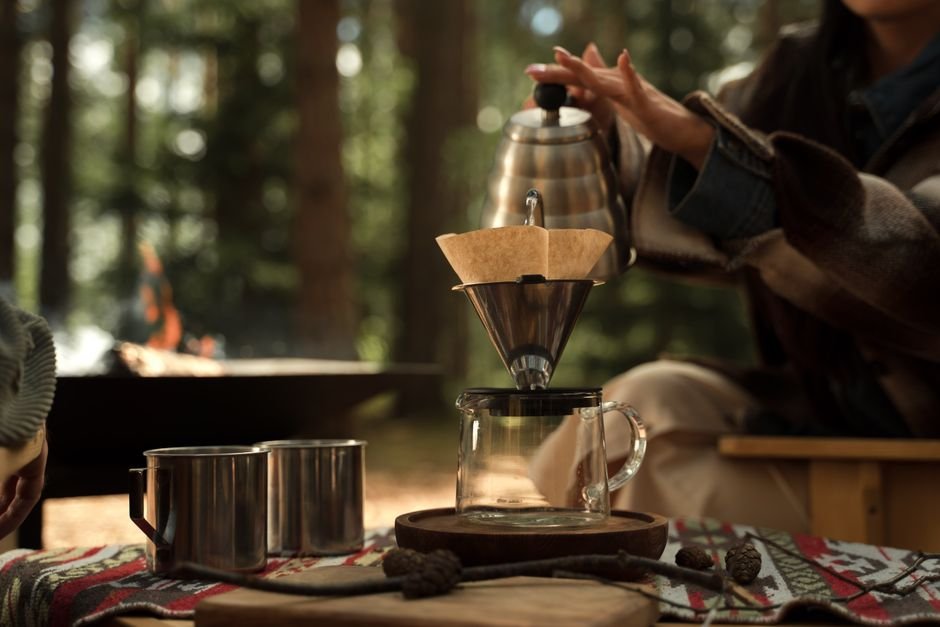
Next I went the other direction and got a small plastic cone that sits on a mug, plus a bag of paper filters. This makes genuinely good coffee. On a still morning at a picnic table it is a nice little ritual, and the cone weighs almost nothing.
Two things eventually pushed me off it. The first is wind. Pour over needs a slow, controlled stream of water and about three minutes of the cone sitting undisturbed on top of a mug. A gust knocks the cone off, or blows the filter sideways, or just cools everything down enough that the coffee comes out lukewarm. I have caught a full cone before it hit the dirt more than once, and lost one entirely.
What I actually use
Most mornings now I do the simplest thing that produces coffee I like, which is grounds in the pot, water poured over, lid on, wait, then pour carefully.
Specifically. I bring water to a boil in a small pot, pull it completely off the heat, and let it sit for maybe thirty seconds so it stops rolling. Then I dump in coarse ground coffee, a heaping spoonful per mug, stir once, put the lid on, and leave it alone for four minutes. Then I pour a small splash of cold water in, which helps the grounds settle to the bottom, and wait another minute.
Then I pour slowly and stop before the pot is empty. The last inch has all the sludge in it and it goes in the ground scraps bag, not down my throat and not on the dirt.
This is basically what I was doing wrong on that first trip, minus the boiling. Boiling the grounds is what made it bitter. Steeping them in water that has come off the boil makes something closer to a French press, which is exactly what it is. No filters, no extra hardware, one pot to wash, and it scales to however many people are up.
Instant is not the compromise it used to be
The good single serve packets that have shown up in the last few years are a completely different product than the tin of freeze dried powder I remember from my grandmother’s kitchen. They dissolve fully, they do not taste burnt, and they are perfectly pleasant with a little sugar. I keep a handful of them in a side pocket of the food bin permanently.
They earn their spot on the mornings when the real method does not fit. Packing up in the rain. A morning where we are trying to be on the trail by seven. The trip where I forgot the pot lid. Hot water plus a packet is thirty seconds and it lets me get on with the day, and I would rather have that than skip coffee and be miserable until lunch.
The failure I want to flag here is the one I keep making anyway. If I do not grind the beans at home the night before, I have to either grind at camp with a hand grinder, which takes several minutes and wakes people up, or drink whatever I brought as backup. I have forgotten to grind at least four times. That is why the packets live in the bin permanently.
Heating the water without babysitting it
A small canister stove is the boring answer and it is usually the right one. Two or three minutes, no fire needed, no smoke, and I can do it before I am properly awake. If I am going to light a fire that morning anyway, the fire does the water instead, but I make sure I have real coals or a steady small flame rather than a big new fire, because the outside of the pot gets thoroughly blackened either way and a roaring fire just does it faster.
If I am cooking over a fire that morning, I make sure the fire is one I am prepared to sit with and put fully out afterward. That means a small one in the provided ring, checked against whatever restrictions are posted at the entrance, and drowned and stirred with water before I leave the site or go to sleep. On a morning where I only want coffee and then want to drive somewhere, the stove is the right tool and the ring stays cold.
What the fussing was really about
Looking back at the percolator and the cone and the grinder, I think I was trying to import a hobby into a place where it did not quite fit. At home I like making coffee carefully. At a campsite in the cold, what I actually want is to be holding a warm mug within about six minutes of getting out of the sleeping bag.
The pot method gets me there and tastes good. The packets get me there faster and taste fine. Everything else was me performing something.
The best cup I have had at a site was not from any special method. It was steeped in a dented pot, poured into a chipped enamel mug, and drunk sitting on a log at about six in the morning with fog still lying on the water and nobody else awake. The method contributed almost nothing to that. The chair and the hour did all the work.