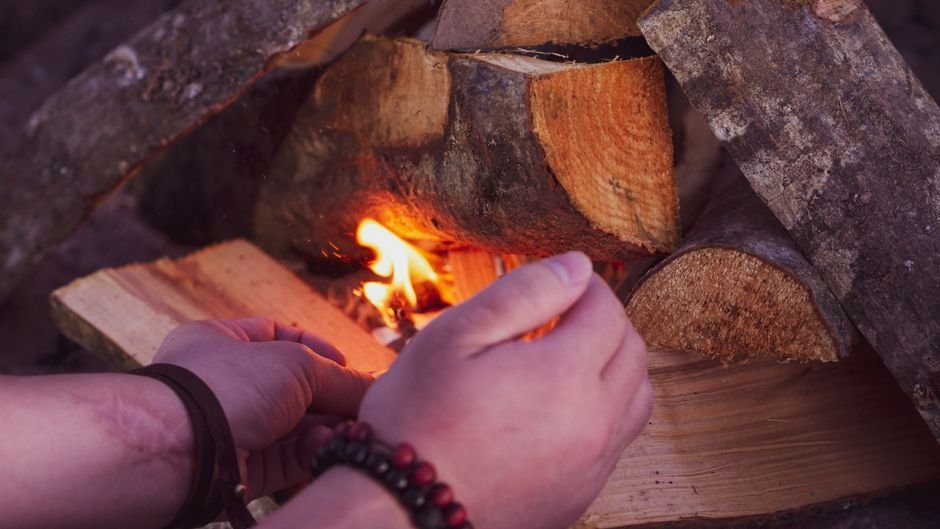
It had been raining since about two in the afternoon, the steady gray kind that never becomes a downpour and never quits either. I pulled into the site a little after five, backed the truck in, and found the firewood bundle I had bought at the entrance sitting in a shallow puddle. Somebody had stacked it very neatly. Somebody had also stacked it in the low spot where the gravel dips.
I spent the next forty minutes proving to myself that I could not light it. Then I ate a cold turkey sandwich in the driver’s seat with the wipers going every thirty seconds, and I thought about what I had gotten wrong. Almost all of it happened before I ever struck a match.
The night I gave up and ate cold
Here is what that failure actually looked like, because I think the failures are more useful than the wins. I crumpled a section of newspaper, put four fat splits on top of it in a rough pyramid, and lit it. The paper went up beautifully. It burned for maybe ninety seconds, curled into black flakes, and went out. The wood was not even warm.
So I tried again with more paper. Same result, except now there was a lot of thick white smoke pouring sideways out of the ring, and when I leaned in close I could hear the ends of the logs hissing. That hiss is water boiling out of the wood. Every bit of heat my little paper fire made went into steaming the log instead of igniting it. I went through most of a box of matches. My knees were soaked. At some point I realized I was angry at a piece of oak, which is a good sign that it is time to stop.
Wet wood is usually only wet on the outside
The next morning the rain let up and I poked at that same bundle in daylight. The outside of every split was dark and soft feeling. But when I knocked two pieces together, a couple of them gave a sharp clack instead of a dull thud. That sound is the fastest test I know. A piece that is soaked all the way through sounds like a wet towel hitting a wall. A piece that is only wet on the surface rings.
Rain soaks in slowly. A split log that sat in the open through one wet afternoon is often damp maybe a quarter inch deep and perfectly dry in the middle. I also look at the end grain. Dry wood cracks and checks as it shrinks, so those little radiating splits in the end are a good sign. Wood that is still heavy and green shows a smooth face with no checking, and no amount of technique is going to save it that evening.
Splitting down to the dry middle
This is the part that changed my wet weather cooking more than any gear I own. I carry a small hatchet, and when the wood is damp I do not try to burn it as it came. I stand a split on end on another piece of wood, set the hatchet edge on it, and tap the back of the hatchet head with a second chunk of wood to drive it through. That gives me two narrower pieces with fresh, dry faces exposed.
Then I keep going. I take one of those halves down to pieces about as thick as my thumb, and a few of those down to pencil thickness. Fresh dry surfaces catch fire. Weathered wet bark does not. I used to think splitting was about making pieces small enough to fit in the ring. It is really about getting to the inside.
I will also shave a few of the thumb sized pieces into feather sticks, curling thin shavings off one end so they stay attached and stand out like a ruffle. It takes a few minutes and a sharp edge. On a wet night those curls are often the only thing that will take a flame.
The tinder I bring from home
Now I keep a small screw top jar with cotton pads worked full of petroleum jelly. One of those, pulled open and fluffed, will burn for several minutes with a real flame, not a flash. I also save dryer lint in a zip bag, which weighs nothing and lights instantly, though it burns fast and needs the cotton to back it up. Cardboard egg cartons dipped in melted candle wax work too, and you can tear off one cup at a time. If I come across fatwood, the resin heavy heartwood from an old pine stump, I keep it, because a few shavings of that will burn wet.
Building it so air can move
My other habit was smothering the fire the moment it looked healthy. I would get a nice little blaze going in the kindling and immediately bury it under three big splits, and then stand there confused while it choked out.
What works for me is a lean to. I put one of the larger damp splits down as a back wall, set the tinder against it, then lean the pencil pieces over the tinder like a roof, then the thumb pieces over those. The back wall reflects heat and the open front lets air in. I do not add anything bigger until the kindling has been burning steadily for a few minutes and I can see coals forming underneath.
Once it is going, I stand the rest of the damp splits on end around the inside edge of the ring, leaning toward the fire. They dry while they wait. By the time I need them an hour later they are noticeably lighter and the ends are steaming rather than soaking. That trick alone has saved several wet nights for me.
When to just not
All of that assumes a fire is a reasonable thing to have that night. Before I unload anything I read whatever is posted at the entrance kiosk and, if there is any doubt, I ask the camp host. Restrictions change fast and they change by season, and I would rather hear it from the person who works there than assume the rules are the same as my last trip. If fires are not allowed, they are not allowed, and I cook on my stove and go to bed early.
And when I do have one, I put it out properly rather than letting it die on its own. I stop feeding it well before I want to sleep, spread the coals flat with a stick, pour water on slowly, stir the wet ash, and pour again until I can hold the back of my hand right over it and feel nothing. Then I pick out any foil or bottle caps somebody left and pack them out. It takes ten minutes and it is the part of the evening I never skip.
That cold sandwich night still stings a little. But I have not been beaten by wet wood since, and mostly what changed was a hatchet and a jar of greasy cotton.