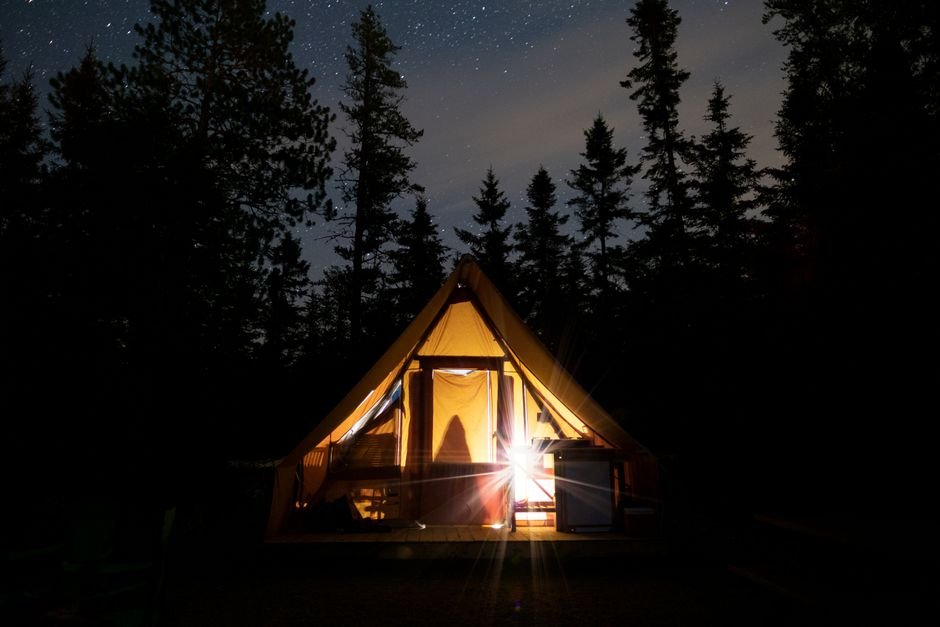
I got to a site at nine fifteen on a Friday night in the fall, which meant full dark, and I spent the next forty minutes doing everything by headlamp with my keys in my teeth. I put the tent up backwards, with the door facing the road, and did not realize until the next morning when I unzipped it and looked straight at a truck. The fly was on but not staked properly, so it flapped against the mesh all night about a foot from my ear.
Nothing went wrong that night in any real sense. I slept, I was fine, the weekend happened. It was just worse than it needed to be, entirely because of what time I showed up.
The three hour rule
What I do now is aim to be parked at the site three hours before sunset. Not three hours before dark, three hours before the sun actually goes down, which gives me a real buffer because dusk stretches for a while after that.
Three hours sounds like a lot for a job that takes thirty minutes. It is not really about the setup. It is about everything that happens around the setup when you are not rushing, and about having room for the thing that goes wrong.
Two hours works most of the time. One hour means the tent goes up and nothing else does, and you eat something out of a bag and go to bed a little annoyed. Zero hours means a headlamp and a backwards tent.
What those hours are actually for
The first thing they buy is the walk. If I have three hours I will walk the loop before committing, check the ground, look at where the water goes, see where the sun will come up. That is the thing that gets cut first when I am late and it is the thing with the biggest payoff.
The second is the chance to move. Setting up a tent and then deciding the spot is wrong is a twenty minute correction in daylight and an impossible one at ten at night. I have moved a tent maybe four times and every one of those moves improved the trip.
The third is that I get to make dinner rather than assemble it. There is a real difference between cooking something at seven with light on the table and eating cold food out of a container because the stove is somewhere in a bin.
And the fourth is the part I actually care about, which is sitting down before the light goes. If I arrive at nine I never get the evening. I get a chore and then sleep. Arriving early enough to sit in a chair for an hour and watch the campground settle is most of why I go.
Arriving too early is a real thing
I overcorrected once and got to a first come place at eight in the morning. The sites were all still occupied by people who had every right to be there until eleven, and I ended up loitering in the parking area for three hours trying not to look like I was hovering over anybody’s site. It felt rude because it was a little rude.
The other thing about very early arrival is that you have too much day and nothing to do with it. You set up in twenty minutes and then you are sitting in a camp chair at nine thirty in the morning with the whole day in front of you and no plan, which sounds nice and in practice makes me restless.
The sweet spot for a first come site is late morning to early afternoon, after checkout is done and before the Friday evening wave. That is also when the host is usually around and knows exactly which sites are turning over.
The dark arrival kit
Sometimes you get in late anyway. Traffic, work, a wrong turn. What I have learned is to plan for it rather than pretend it will not happen.
I keep a small bag in the truck with a headlamp on top, a spare headlamp, and a lantern I can set on the table so I am not lighting the whole site with something strapped to my forehead. Anything I need in the dark lives in one bin, not spread across four.
The bigger habit is doing less. If I arrive after dark I put up the tent, throw the pad and bag in, and stop. Kitchen, chairs, tarps, all of it waits for morning. It is faster, it is quieter for the neighbors, and it means I am not making decisions about the site layout when I cannot see the site.
I also set the tent up with the door facing away from the road by default now, without thinking about it, because that one rule would have saved me the morning I unzipped and met a bumper.
Working backwards from the site
Since I want to be parked three hours before sunset, I work backwards from that number instead of forwards from when I finish work. Sunset time, minus three hours, minus drive time, minus a stop for gas and food, minus thirty minutes of slop because there is always thirty minutes of slop.
Doing it in that direction changes the decision. Working forwards, I tell myself I will leave right after work and it will be fine. Working backwards, I find out that leaving right after work puts me at the site at nine, and then I either take a half day or I accept the late arrival honestly instead of being surprised by it.
The drive time estimate is the part I still get wrong. The last stretch to most campgrounds is slower than any map thinks it is, because it is narrow and it winds and there is a gate. I add twenty percent to the final leg and I am still occasionally optimistic.
What the mornings have to do with it
There is a connection between arriving early and the reason I camp at all. A late arrival means I go to bed keyed up and I sleep badly and the first morning is spent recovering from the drive. An early arrival means the first night is a real night and the first morning is a real morning.
Two nights out is not much time. If one of them is spent unwinding from a bad arrival, I have cut the trip in half. Getting there three hours before dark is the cheapest thing I do to make a weekend feel longer than it is.