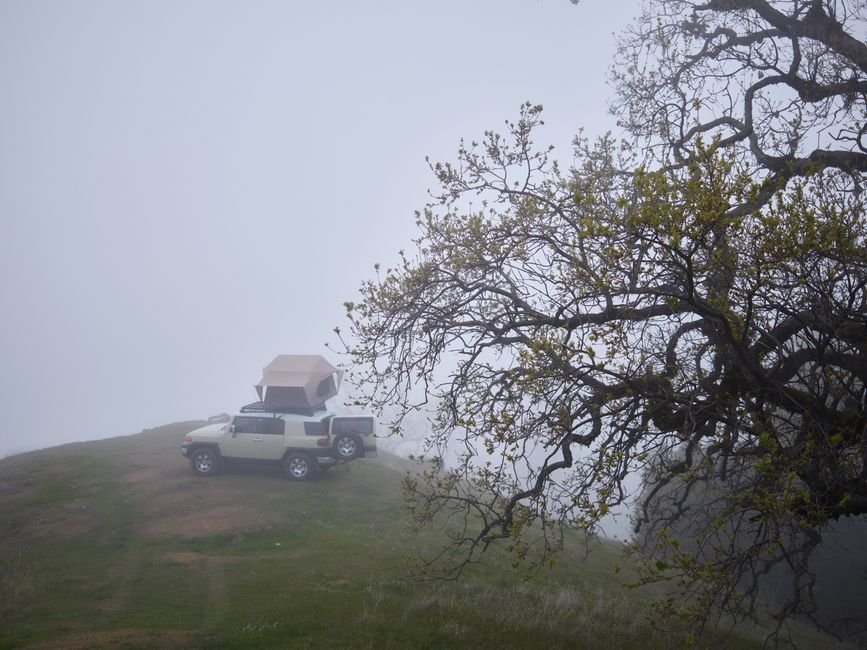
I sat in the truck at the entrance station on a Friday afternoon reading a handwritten sign that said the campground was full, with a second line underneath about a site or two possibly opening on Saturday. It was four hours behind me and about ninety minutes of daylight ahead of me. I had not booked anything because the weather had been uncertain all week and I had told myself I was being flexible.
I was not being flexible. I was being vague, which is a different thing, and the difference is that flexible has a plan B written down.
What booking ahead actually buys
The obvious thing it buys is a guaranteed spot, and that matters more than I like to admit on a summer weekend within a couple hours of a city. But there are two less obvious things.
The first is that it removes the arrival gamble from the drive. When I have a site confirmed I drive at a normal pace, stop for coffee, and get there when I get there. When I do not, I find myself pushing to leave earlier, watching the clock, and getting mildly stressed about a thing I cannot control from the driver’s seat.
The second is that it lets me pick a specific site rather than accept whatever is left. If I have studied the loop layout and I know that a certain corner of a certain loop has the sites with real separation between them, booking is the only way to get one. Late arrivals get whatever nobody wanted, and there is usually a reason nobody wanted it.
What booking ahead costs
The cost is that you commit to a place and a date long before you know anything useful about either. Six months out I do not know the weather, whether I will be tired, whether a fire restriction will have turned the trip into something else, or whether the reason I wanted to go will still be there.
I got locked in once during a stretch of hard weather. Not dangerous, just relentless, three days of low cloud and rain that never became a storm and never stopped. I stayed because I had paid and because leaving felt like quitting. I should have driven two hours the other direction where the forecast was clear, and the only thing stopping me was a reservation worth less than a tank of gas.
The other cost is smaller and more annoying, which is that booking well ahead pushes you toward the popular places. The big managed campgrounds with the reservation systems are the ones that fill first and the ones everybody has heard of. The quieter options are often the ones that do not take bookings at all.
The first come sites, and how they really work
First come sites are not a lottery. They run on a schedule, and the schedule is mostly about checkout time and about who is willing to be inconvenient.
The turnover happens in a window in the late morning, usually somewhere between ten and noon, when the previous night’s campers pack up. If you show up at two in the afternoon on a Friday you are arriving after that window has closed and before the evening arrivals give up. If you show up at eleven you are watching it happen. That is the single most useful thing I know about first come camping and it took me an embarrassing number of trips to notice.
The other half is which days. Thursday nights are a different world from Friday nights. Sunday through Wednesday, most places I go are half empty, and I have walked into a loop with fifteen open sites in the middle of a season when the same loop was full three days earlier.
How I actually decide now
My rule is not complicated. If the trip has a fixed date that I cannot move, I book. If the trip has a fixed place that I really want, I book. If neither of those is true, I go without a booking and bring a plan B.
A fixed date usually means other people are coming. If a friend has arranged time off and is driving in from somewhere, I am not going to hand them a gamble. Same for anything tied to a specific weekend on the calendar.
A fixed place usually means I want a particular site or a particular loop because of something I learned on a previous trip. If I have written down that a specific corner of a specific campground has the morning light I want, I am not going to leave that to whoever gets there first.
Everything else, which is most of my camping, is unbooked. I go midweek when I can, I leave early, and I accept that I might sleep somewhere other than my first choice.
What a real plan B looks like
The mistake I made at that entrance station was having a vague sense that something else would exist nearby. Now, before I leave the house, I write down three options and I write down how far apart they are.
Option one is where I actually want to go. Option two is another campground within about forty five minutes, ideally one that is less known and does not take reservations. Option three is a dispersed area or an overflow lot where I know camping is allowed, which is not going to be a nice night but is a guaranteed one.
I check whether any of them close seasonally and I check whether the road in is the kind of road my truck is happy about after rain. I save the maps offline because there is usually no signal at the point where I need to make the decision. And I decide in advance what my cutoff time is, which for me is about an hour before dark. If I have not got a spot by then, I stop looking and take option three.
The trip that made me stop worrying about it
The Friday I got turned away, I drove twenty five minutes to a smaller place I had noticed on the map on the way in. It had eight sites, no reservations, a pit toilet, and a hand pump for water. Four sites were open. I took one at the end with a stand of trees behind it and had the best two nights of that whole spring, mostly because I had spent the afternoon expecting to sleep in the truck.
That did not teach me that booking is unnecessary. Some weekends are genuinely full for fifty miles and no amount of optimism fixes it. What it taught me is that the anxiety I had about not booking was mostly about not having thought it through. Once I started writing down three options before I left the driveway, the choice between booking and not booking stopped feeling like a risk and started feeling like a preference.