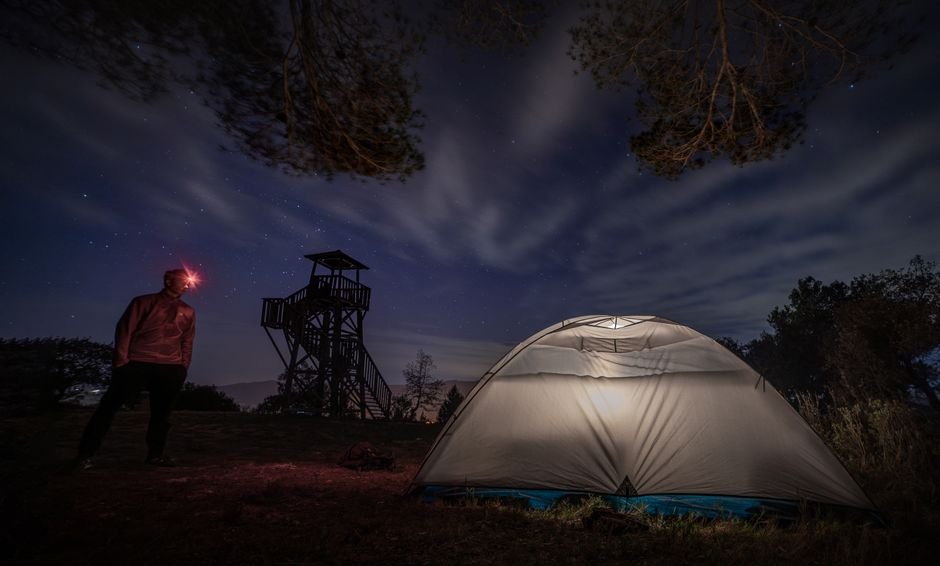
The site next to me had two kids under six and a dog, and my first reaction when they pulled in on Friday evening was a small internal sigh. By Sunday morning the older kid had shown me a rock she was very serious about and the dad had lent me a lighter, and I drove home thinking about how quickly I had judged a family for the crime of arriving.
A campground puts you about twenty feet from people you have never met, with no walls, for two or three days. That is closer than most of us live to our actual neighbors at home. The odd thing is that it mostly works, and the reason it mostly works is a set of small unwritten habits that nobody explains to you.
The weekend I was the problem
I want to start with this because it is easy to write about bad neighbors and harder to admit being one. I got in late on a Friday, after ten, in a truck with a tailgate that does not close quietly. I set up a tent in the dark with a headlamp on the bright setting, swinging it across two sites every time I turned my head. I dropped a stuff sack of poles on the gravel. Twice.
Nobody said anything. In the morning the man next to me was perfectly friendly, which somehow made it worse. I have thought about that arrival a lot. It cost me nothing to be careful and I simply was not paying attention.
Now if I get in after dark I do the minimum. Tent, pad, bag, sleep. Chairs and kitchen and the rest of it can wait for daylight, and the truck doors get closed with a hand rather than a swing.
Light travels further than sound
Everybody worries about noise and almost nobody thinks about light, and light is the thing that actually comes through a tent wall. A headlamp on high pointed at your neighbor is like someone shining a flashlight through your bedroom window.
I run mine on the lowest setting that lets me do the task, and I have gotten in the habit of turning my whole head away before I look up at somebody I am talking to. The red setting is worth using for anything around camp after ten. It is not about night vision for me, it is that red does not carry into a tent the same way.
The same goes for a lantern hung high on a pole, which lights up three sites, and for headlights. If I am arriving late I try to shut the engine and the lights off as soon as I can see well enough to park by feel.
Nobody walks through a site
This is the one rule that seems obvious and that I see broken constantly, mostly by people cutting the corner to the bathroom. A site is somebody’s living room for the weekend. The invisible lines run along the edge of the gravel and out to the back of the picnic table, and you go around, even if around is thirty extra steps in the dark.
It matters most with kids and dogs, who have no natural sense of where a site ends. Nobody in the loop minds a kid on a bike on the road. Cutting between two tents at seven in the morning is a different thing.
Sound after dark and what quiet hours really mean
Most places post quiet hours somewhere around ten at night to six or seven in the morning. In practice quiet hours are not a rule about volume so much as a rule about what kind of sound. Conversation at a normal level carries a surprisingly short distance. Laughter, a speaker, a car door, a generator, a dog, and a chopping axe all carry a long way.
The one that surprises people is music. There is no volume at which a speaker outdoors is only heard at your own site. If I want music I use one earbud, and honestly I have mostly stopped wanting it, because the whole point of the trip is the sound the place makes on its own.
Mornings deserve as much care as nights and get less of it. I am up early and I like it that way, but the first hour is for quiet things. I set the stove up the night before so I am not rummaging through bins at five thirty. Metal on metal at dawn is the loudest thing in a campground.
The small courtesies that buy goodwill
Introduce yourself in daylight, briefly. It takes ten seconds and it converts the people next door from an abstract threat into a family named something, which changes how everybody behaves for the rest of the weekend.
Point your smoke with some thought when you build a fire. You cannot control wind, but you can notice which way it is going and where their tent door is, and you can let the fire die down earlier than you planned if the smoke is settling in the wrong direction.
Keep your gear on your own gravel. Leave the site cleaner than you got it, including the fire ring, because the next person reads the ring as a message about what kind of place this is. If a neighbor is struggling with something, offer once, then leave it alone.
When distance is the only fix
Sometimes there is no etiquette solution. A group settles in at the site next door with a generator and a plan for a long night, and no polite conversation is going to change that. I have asked once or twice, kindly, and it has gone fine both times, but I do not count on it.
Which is why I now think about neighbor distance while I am picking a site rather than after. I look at whether the sites are separated by real vegetation or just by a line on the ground. I look for a site with only one adjacent neighbor instead of two, usually at the end of a spur or on the outside of a curve. I avoid the big sites near the group area.
Twenty feet with a screen of brush between it is a different world from twenty feet of open gravel. That is not something you can tell from a map, which is one more reason to walk the loop before you unload.