Saturday morning, six fifteen, about forty degrees. I am standing at the picnic table in a fleece with the hood up, and I have laid out eggs, a carton of cream, shredded cheese, a bell pepper, an onion, a package of sausage, tortillas, and a cutting board. It looks like a cooking show set. It is very cold and nothing is happening.
By the time I actually ate that morning it was past ten. The eggs were fine. Everything else had gone lukewarm waiting on the eggs, my hands were stiff, and I had missed the light coming through the trees, which is the entire reason I get up early at a campsite in the first place.
What I was actually doing wrong
I was cooking at camp the way I cook at home, where I have four burners, a sink, running hot water, and a counter I can leave a mess on. At a site I have one burner, or a fire that needs twenty minutes of attention before it is worth cooking over, and one bin of water that I have to walk to a spigot to refill.
So every dish I added did not cost me its own cooking time. It cost me its cooking time plus a pan wash plus a repack. Chopping an onion at a picnic table with cold fingers takes twice as long as it does at home. Three components meant the first one was cold before the third one was done, and I have no oven to hold anything warm.
The other thing I was doing wrong was starting the food before the coffee. That sounds minor. It is not. I am useless and slow before coffee and I make bad decisions about heat.
The order that fixed it
Now the sequence is fixed and I do not deviate from it. Water on first. While it heats I put on my boots properly and get the food out of the cooler. Coffee gets made and I drink some of it standing up, doing nothing else. Then, and only then, one pan goes on the heat.
That single change moved my breakfast from ten in the morning to about seven fifteen, and it did not require any new gear at all. The coffee is the thing that has to happen first, because everything downstream of it goes faster.
I also do all the cutting at home now. If something needs to be diced, it gets diced in my kitchen on Thursday night and goes into the cooler in a container. This feels like cheating. It is not. Nobody is grading me on where the onion got chopped.
The breakfast itself
Here is what I make most mornings. One skillet on medium heat. Sausage or bacon goes in first and cooks until it is done, then I push it to one side of the pan or pull it onto a plate. There is now fat in the pan, which I am going to use.
Eggs go in next, scrambled loose in a cup beforehand so I am not fighting a shell over a hot pan. I stir them slowly with a wooden spoon and pull the pan off the heat while they still look slightly underdone, because they keep cooking. Cheese on top if I brought it. Everything goes into a tortilla, or onto a slice of bread, or just onto the plate with the meat.
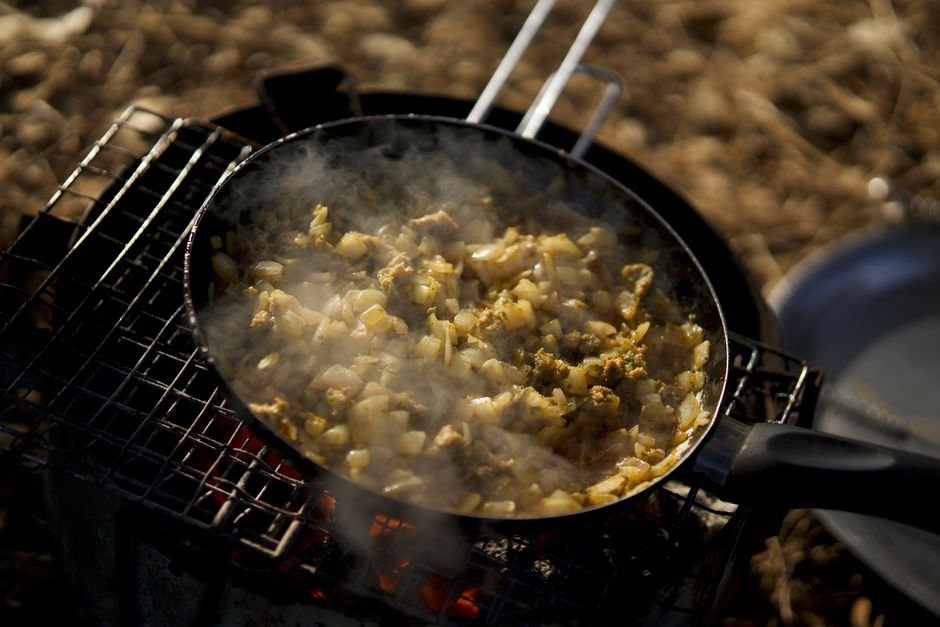
That is it. Two things in one pan, maybe eight minutes total. If I want vegetables I cook them in the fat before the eggs go in, and they are always pre chopped. If I want potatoes, they are the boiled ones from home that just need to be crisped up, because raw diced potatoes in a camp skillet take twenty five minutes and I have burned the outside while leaving the middle raw more times than I want to admit.
Cooking over the fire versus the stove
I like cooking breakfast over coals. It tastes better to me, and standing over a fire in the cold is half of why I am there. But I only do it when I have the morning to spend.
The honest math is that a fire I light at six fifteen is not ready to cook on until close to seven, because I do not want flames under a skillet, I want a bed of coals raked flat. Flames give you a scorched outside and a raw middle and a pan blackened in a way that takes real work to scrub. Coals give you something close to a stovetop.
So on a lazy Sunday I will build the fire first, make coffee on the stove while it burns down, and cook on the coals once they are gray and even. On a morning where we are hiking at eight, the stove does breakfast and the fire does not get lit at all. Pretending otherwise is how you end up eating at ten.
The mess is part of the meal
The cleanup used to be an afterthought and it is really not. A greasy skillet at a site with no hot water is a genuine problem, especially if you are leaving in an hour.
What I do is wipe the pan out with a paper towel while it is still hot, which gets most of the fat, and then pour a little water into the warm pan and let it sit while I eat. By the time I am done, whatever is stuck has loosened and comes off with a plastic scraper and very little scrubbing. That water goes into the gray water drain, not on the ground behind the site, and any food bits get fished out and go in the trash.
Food scraps left around a site are a problem for the next person and a bigger problem for the animals that learn to visit. I am fussy about it. The whole kitchen goes back in the bin before I sit down with the second cup of coffee.
Why simple turned out to be the point
But most weekends I am at a site for two nights, and the mornings are the best part. The light is low and orange, the ground is still damp, there is usually nobody else awake, and it is quiet in a way that my street never is. Spending the first three hours of that hunched over a stove getting frustrated was a bad trade.
Now breakfast takes about fifteen minutes from lighting the burner to sitting down. I eat it at the picnic table with a mug, watching the site slowly wake up around me. The food is not impressive. It is eggs and sausage in a tortilla. It is also the meal I look forward to for most of the week, and I think that is because I stopped asking it to be anything more than that.