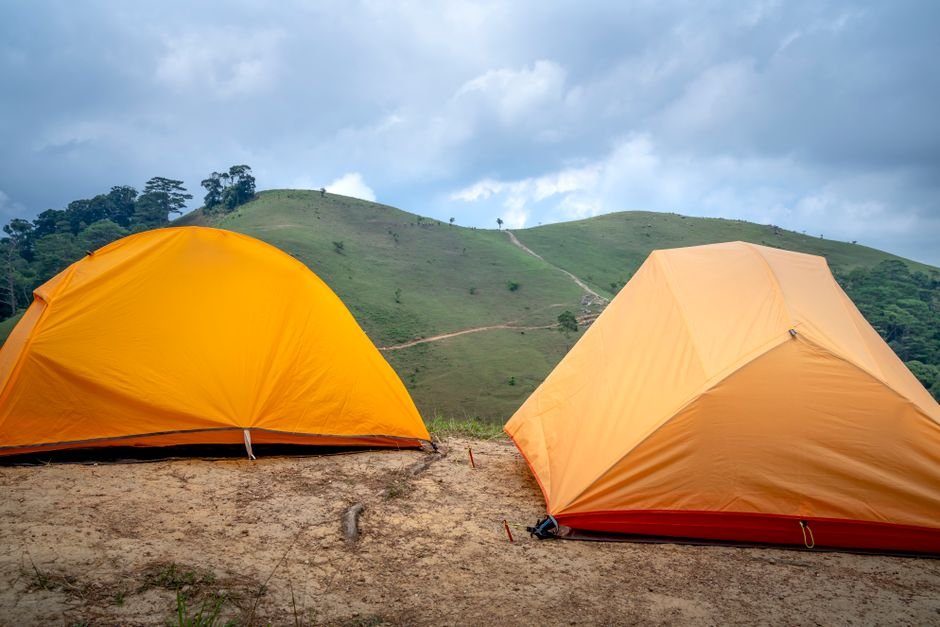
It started raining around one in the morning, which I had expected, and by three I was awake because my elbow was wet. Not damp. Wet. I put a hand down flat on the tent floor and it pushed water out from under my palm in a small wave. The floor had turned into a waterbed and I was floating in the middle of it in a sleeping bag that was doing its best.
I had picked that spot for the best possible reason and the worst possible reason at the same time. It was the flattest, greenest, softest looking patch in the entire site. I remember being pleased with myself about it.
Green grass is a warning, not a feature
Everything else in that site was scrubby and brown and packed down from tires and boots. My spot was a neat little lawn. It took me until I was standing outside at three in the morning in a headlamp, watching a thin sheet of water move across the site and pool exactly where my tent was, to understand that the grass was green because that is where the water always goes.
Grass grows well in the low corner because the low corner stays wet. Moss on the ground says the same thing more loudly. So does soft dirt in a place that should be packed. I now read a lush patch in an otherwise dry site as a mark on a map that says water collects here, and I set up somewhere else.
Level and dry are two different questions
The thing that fooled me is that low ground is often the most level ground in a site, because that is what water does over time. It carries fine material downhill and drops it in the flat spot, which smooths the flat spot out even further. So the place your body wants, the place that promises you will not slide all night, is very often the place a storm is going to find.
What I want now is ground with a slight, boring tilt to it. Half an inch of fall across the length of the tent is nothing to sleep on and it is enough to keep water moving past instead of stopping. If I have to pick between perfectly level and slightly sloped with somewhere for water to go, I take the slope now without much thought.
Crowned ground is the ideal. A spot that is a hair higher than its surroundings on every side, even by a couple of inches, will keep you out of trouble in almost any rain that a weekend camper is going to sit through.
How to read a site for water in five minutes
I stand at the highest corner of the site and imagine a bucket poured out at my feet. Where does it go. That sounds silly and it works, because you can usually see the answer once you look for it.
Then I look for the physical evidence, which is more honest than my imagination. Small fans of sand or silt spread out where flowing water slowed down and dropped its load. Little channels an inch wide cut into the dirt. Pine needles and leaf litter piled in a line, which is a debris line and marks exactly how far the water came last time. A ring of fine grit around the base of a tree. Sticks all lying in the same direction.
Those signs tell you what happened the last time it rained hard here, and the ground does not exaggerate.
What I do once the tent is up
I do not dig trenches around my tent. Plenty of older camping advice says to and most places ask you not to, because you are cutting a scar into ground that other people will use after you. It also does not work as well as choosing the right spot in the first place.
What I do instead is small and takes two minutes. I clear the loose debris out from under the footprint so I am not sleeping on a sponge of wet needles. I make sure the footprint or ground sheet does not stick out past the edge of the tent floor anywhere, because any lip sticking out catches rain running off the fly and funnels it under you. That one detail causes more wet nights than bad tents do.
I stake the fly out properly and tight so it sheds water away from the walls instead of sagging against them. Then I look at where the fly is going to drip and make sure that line is not directly over my pack, my boots, or the spot where I am going to stand in the morning.
Surfaces, ranked by how they treat you
Gravel pads are the most reliable thing in a developed campground. They are built up slightly, they drain fast, and they are unpleasant on the knees and fine everywhere else. If a site has a gravel tent pad I use it, even when the grass beside it looks nicer.
Sand drains beautifully and holds stakes poorly. It also gets into everything you own for the rest of the trip. Pine duff is comfortable and dries slowly, and it hides roots. Packed dirt is fine when it is truly packed and terrible when it is a thin dry crust over clay, because clay takes almost no water before it starts shedding it sideways.
Grass is the one I am most careful with now, for the reason that whole night taught me. Grass in a wooded upland site is usually fine. Grass in a low bowl in an otherwise dry campground is a puddle waiting for a reason.
What the wet night actually cost
Not that much, honestly, which is why I can write about it lightly. I lost a night of sleep, a sleeping bag that took two days on a line at home to dry out, and a paperback. I did not lose the weekend. I moved the tent at first light to a lumpy uphill spot twenty feet away that I had walked past twice, made coffee, and sat there watching the water still standing in my beautiful green rectangle.
That image did more for my camping than any piece of gear I have bought since. Now the first question I ask in a new site is not where the tent fits or where the view is. It is where the water goes. Everything else is negotiable and that one is not.