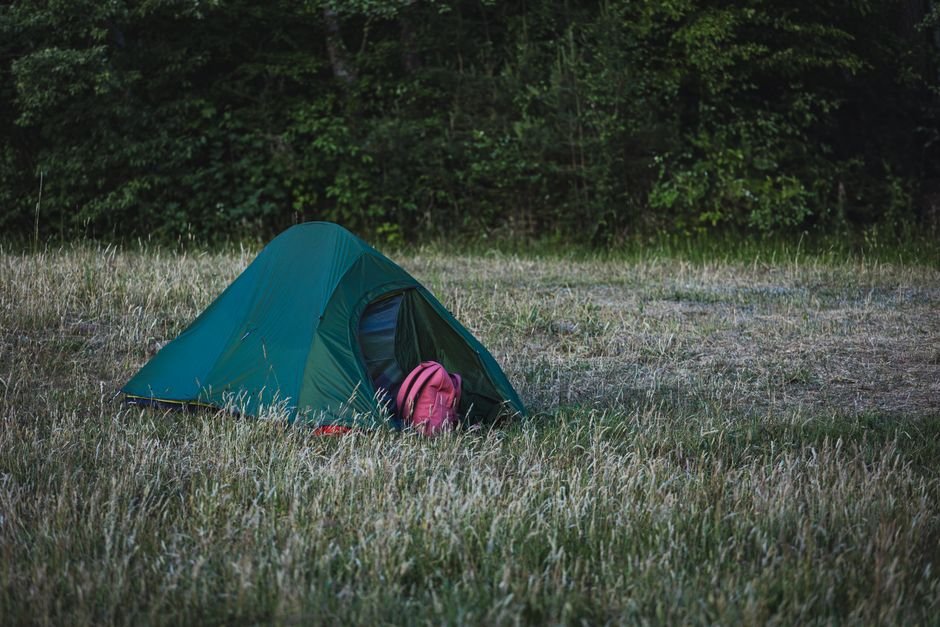
There is a site at a small lake campground I go to where the tent pad is a rectangle of packed gravel with a wood border, perfectly level, no roots, no rocks. The first time I got it I thought I had won something. I set up in about eleven minutes, sat at the picnic table with a beer, and felt like a person who had finally figured out how to do this.
That was one of the coldest nights I have had, and I had brought a warmer bag than the trip needed. The gravel had been sitting in shade all afternoon and it was more than happy to take everything I had.
Air Above You, Ground Below You
Here is the thing I did not understand for an embarrassingly long time. The cold air around you and the cold ground under you do not take heat from you the same way, and the ground is far better at it.
Air is a poor conductor, and your sleeping bag works by trapping a layer of still air around you so the cold air outside never touches your skin. That works well. But underneath you, your body weight crushes the bag’s insulation completely flat. There is no trapped air left down there. The bottom of your bag is doing essentially nothing, and you are lying in direct contact with a surface that has an enormous capacity to absorb heat and no interest in giving it back.
Dirt, gravel, rock, and especially wet ground will pull heat out of you steadily for as many hours as you lie there. It does not fluctuate the way air temperature does. It does not warm up when the sun hits the tent fly. It just keeps going.
Once that clicked, a lot of my bad nights made sense in retrospect. I had been cold from below every single time and treating it as a problem with the air.
A Picnic Table, A Flat Spot, And A Bad Night
Back to the gravel pad. What I did not consider is that a compacted, level, well drained tent pad is basically the ideal surface for conducting heat away from a person. No air pockets. No duff. Nothing between me and a slab that had been giving up its warmth since three in the afternoon.
Compare that to a spot I took later that same year that I initially thought was worse: slightly uneven, on a bed of pine needles and old leaves, with a bit of a slope I had to work around. That night was noticeably more comfortable and the air was not any warmer. The layer of organic material under the tent was doing real work, because it was full of air.
I do not want to oversell that. A few inches of leaf litter is not a substitute for a proper pad. But it is a free upgrade if you look for it, and now I do look for it. Duff over gravel, dry over damp, and never the low spot near water if I have a choice.
What Goes Under Me Now
The change that ended most of my cold nights was boring. I stopped thinking of the pad as a comfort item and started thinking of it as insulation that happens to also be comfortable.
Thickness is not the same as insulation, which is the trap I fell into first. A cheap air mattress can be very thick and very comfortable and still be nearly useless in the cold, because the air inside it moves. It circulates, picks up cold from the bottom surface, carries it to the top, and delivers it straight to your back all night. Some people describe those as feeling like sleeping on a cold water bed and that matches my experience exactly.
What works is insulation that holds still air in place: closed cell foam, or a pad built with internal structure or fill designed to stop that circulation. Pads carry an insulation rating for this, and it is worth learning what your specific pad’s rating actually means rather than guessing from how plush it feels.
The other thing I do on genuinely cold trips is stack. A basic foam pad underneath, the inflatable on top. It is bulky and it looks like overkill and it works better than either one alone. Car camping means the bulk costs me nothing except a bit of trunk space, which is exactly the kind of trade drive up camping is good for.
The Site Matters As Much As The Pad
I choose sites differently now. I look at what is under the tent before I look at whether it is flat, and I look at where the site sits before either of those.
Cold air is heavier and it flows downhill and pools. A site in a dip, at the bottom of a loop, or in a meadow next to a creek will run colder overnight than a site fifty feet up the slope, sometimes by a lot. The pretty spot next to the water is almost always the cold spot, and it is almost always the one still available when you show up late, which is not a coincidence.
I also avoid pitching directly on damp ground. Wet dirt conducts heat far better than dry dirt, so a site that drains well and has been in the sun matters more than the couple of degrees you might gain elsewhere.
Cots Are Not The Fix People Assume
Every time I mention cold ground somebody suggests a cot, and I understand the logic. Get up off the dirt, problem solved.
It does not work that way. A cot puts you on a thin piece of fabric with moving air on all sides of you, so instead of losing heat to the ground by conduction, you lose it to circulating air underneath. In my experience a bare cot on a cold night is worse than a decent pad on the ground, not better. If you want to use a cot in the cold, you still need a pad on top of it. The cot is a comfort choice, not a warmth choice.
Same with putting a tarp under the tent and calling it insulation. A ground sheet keeps moisture out, which is genuinely useful, but a thin sheet of plastic has no insulating value at all.
The Cheapest Upgrade I Ever Made
A basic foam pad costs less than a tank of gas and weighs almost nothing, and adding one under what I already owned did more for my sleep than a season of thinking about bags. That is the whole lesson.
If you are getting cold at night and you are about to spend real money solving it, spend the small money first. Fix what is under you, pick a site that is not sitting in a cold pocket, and see what is actually left of the problem. For me there was not much left.