Two years before my first trip, I had a shopping cart open with eleven items in it and a total somewhere north of nine hundred dollars, and I closed the tab. Then I did that again in the spring. Then again the following fall. I did not go camping for two years, not because I did not want to, but because I had decided somewhere along the line that going required first becoming a person who owned camping equipment, and becoming that person was expensive, so it kept getting postponed.
The checklist was the obstacle
What kept regenerating that cart was a checklist. I would read a beginner article, and it would list what you need, and the list was always long and always full of categories I had no opinion about. Sleep system. Cook system. Layering. Each item linked to three options at three price points, and picking between them required knowledge I did not have and could only get by going, which I was not doing, because of the list.
I do not think those articles are lying. If you camp thirty nights a year, the difference between a good pad and a bad one is real and worth paying for. But a list written for someone who camps thirty nights a year is the wrong document for someone trying to spend two nights at a drive-in campground ninety minutes from home, and I could not tell the difference yet.
What I actually took the first time
The trip finally happened because a friend said he had a tent I could borrow and asked if I was free that weekend, and the question was small enough that I said yes before the cart could reopen.
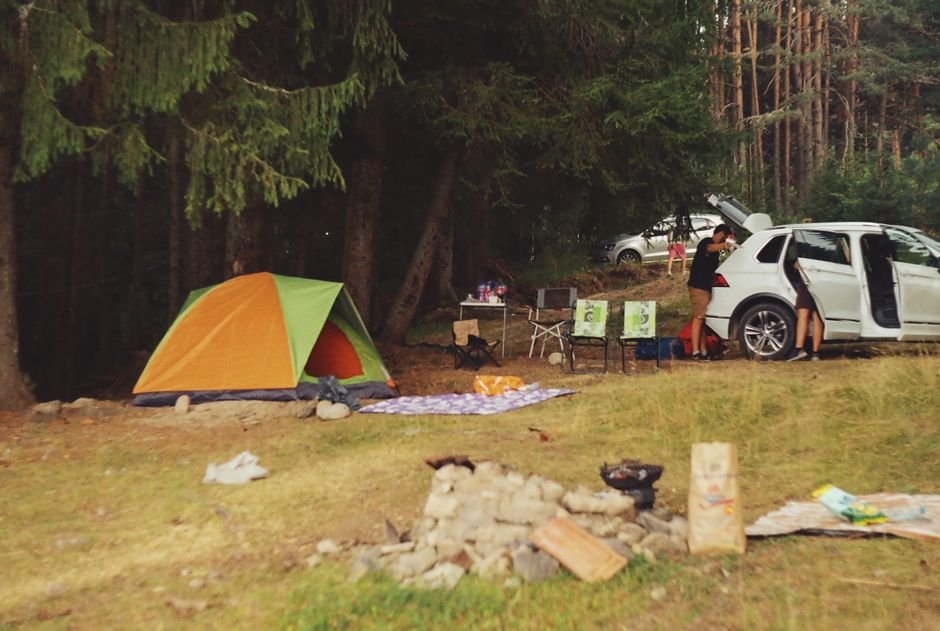
The tent was his. The sleeping bag was a hand-me-down from a cousin, a summer bag, fine in July. The pad was the cheapest foam one at the store near my apartment. My “camp chair” was a folding chair from my kitchen, which is heavier and worse than a real one and worked completely. I cooked on a small stove I borrowed from the same friend, ate off two plates from my kitchen cabinet, and drank coffee out of a mug I already owned that has a chip in the handle.
The clothes were the ones in my closet. Jeans, a fleece, a rain shell from a trip to a city where it rained a lot. Boots I already had. The only things I bought were the foam pad, a headlamp, and a cheap cooler, and the total was under sixty dollars.
The stuff I did buy, I bought wrong
Even that small amount, I did not spend well, which is sort of the point. The cooler was too big, which I have written about elsewhere and still resent slightly. The headlamp was the cheapest one on the rack and its beam was so narrow it made the dark worse instead of better.
If I had spent nine hundred dollars in that cart, I would have made the same category of error across eleven items instead of two, and I would have made it with no information at all, because I had never spent a night out. Every good gear decision I have made since came from a specific annoyance on a specific trip. The pad was too thin and I got cold from underneath, so the next pad was thicker. The narrow beam bothered me, so I got a lantern. The cooler was too big, so the next one was small.
You cannot have those annoyances in advance. Buying first is buying blind.
Borrowed gear is not a lesser version
There is a slightly embarrassed way people talk about borrowed and hand-me-down gear, like it is a temporary condition you are trying to grow out of. I no longer see it that way at all.
Borrowing has a real advantage beyond price, which is that you get to try a specific object before you decide whether you want that kind of object. I slept two nights in my friend’s tent and learned that I wanted more headroom than that, which is not something I would have known to ask about in a store. When I eventually bought a tent, that one preference drove the whole decision.
The main cost of borrowing is that you owe someone care. I returned that tent dry, clean, and with all eight stakes, which took me twenty minutes in my parking lot on a Sunday afternoon. That is the whole social contract and it is not a heavy one.
The two things I would spend on first
If someone told me they had a little money and wanted to know where it goes, I would not start with the tent, which surprises people. Tents are the most borrowable thing there is, and almost any tent keeps rain off for two nights in a campground.
I would spend it on sleep. A pad that actually insulates you from the ground, and a bag rated colder than you think you need. Every genuinely bad night I have had outdoors came down to one of those two, and no amount of nice cookware makes up for lying awake at three in the morning doing arithmetic on sunrise.
After that, a light you can see the whole site with. Then whatever the last trip made you wish you had, which is a shopping list that writes itself and never contains anything you do not want.
The trip is the thing, not the kit
What actually happened on that first borrowed-gear weekend is that I sat by a fire in a kitchen chair, ate a mediocre dinner off a plate from my apartment, slept poorly on a thin foam pad, and woke up to fog on a lake with nobody else awake. None of the good parts of that were purchased.
The nine hundred dollar cart would not have improved a single hour of it. It would have delayed the whole thing by another season, which is exactly what it had already done twice.
If you are sitting on a version of that cart right now, close the tab and text whoever you know who owns a tent. Two nights and sixty dollars is enough to find out what you actually need, and it is the only way to find out that works.