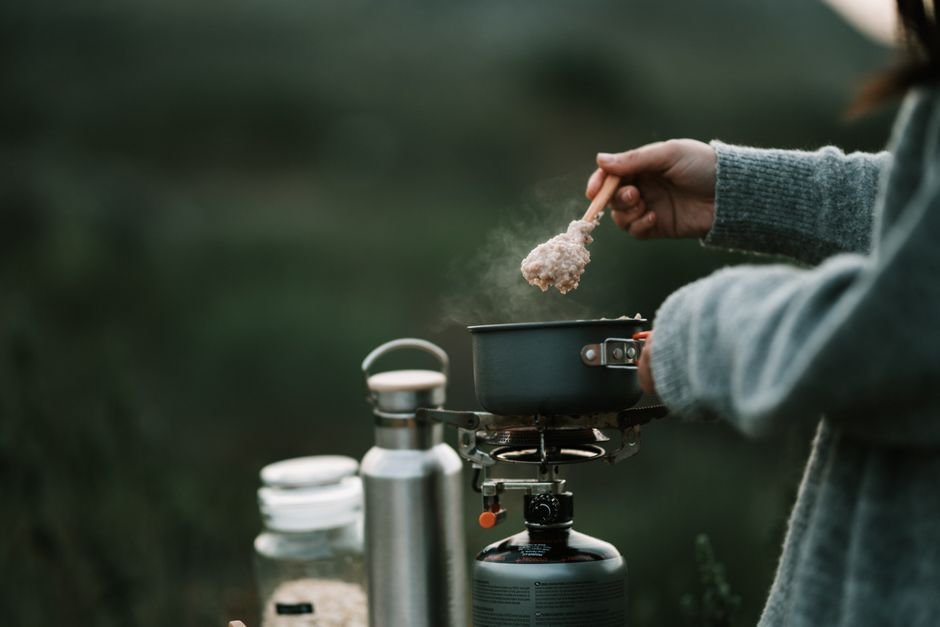
The trip that convinced me was a two nighter in early spring where I somehow left the second pan on the kitchen counter at home. I had a twelve inch skillet, a lid that did not really belong to it, and food planned for meals that needed two burners. I was annoyed about it for about an hour and then made the best camp dinner of that year, and I have not gone back to two pans since.
What I learned is that the constraint is not really a constraint. Almost everything I want to eat at a site cooks fine in one vessel if you think about the order things go in.
The order is the whole trick
Everything that follows works the same way. Fat first, then the thing that takes longest, then the things that take less time, in descending order, with liquid added at the point where you want things to stop browning and start simmering.
That is the entire method. Sausage before onions, onions before garlic, garlic before the liquid, because garlic burns in about forty seconds over coals and turns the whole pan bitter. I have ruined a dinner that way and it is not fixable once it happens.
If something absolutely has to stay separate, it comes out of the pan and sits on a plate under foil while the rest cooks, then goes back in at the end. The plate is the second pan. It costs nothing and it does not need washing beyond a wipe.
Things that work every time
Sausage and beans is the one I make most. Brown sliced sausage in the pan, pull it aside, cook onion and pepper in the fat, add a can of beans with most of the liquid, add the sausage back, simmer until it thickens. Fifteen minutes. It reheats well the next morning with an egg on top, which is a nice bonus on a two night trip.
Pasta with whatever is in the cooler works if you cook the pasta in less water than you think, so you do not have to drain it. Roughly enough water to cover, stirred often, and by the time the pasta is done the water has mostly become a starchy sauce. Add cheese and butter and pepper off the heat. No colander, no draining a pot of boiling water into the dirt in the dark, which is a thing I used to do and should not have.
The ones that taught me the hard way
I tried to make a stew with raw cubed potatoes and carrots over a fire that was still mostly flame. Forty minutes in, the bottom of the pan had a black crust, the top was still cold, and the carrots were raw in the middle. I ate the middle layer and threw the rest out. Raw root vegetables need low even heat for a long time and a fire that has not burned down yet gives you the opposite.
I tried a frittata style thing where you cook eggs with everything in them and finish it with a lid on. It fused to the pan. I lost most of it to the scraping. What I did not do was let the pan preheat properly and get enough fat in before the eggs went in, and a hot dry pan with eggs in it is a welding operation.
I tried cooking two things at once by pushing one to the side of the pan, which works over a stove where the heat is even and does not work at all over coals where one side of the pan can be a hundred degrees hotter than the other. Now I use the plate.
The general lesson from all three is that the fire was wrong, not the recipe. Almost every one pot failure I have had was me cooking over flames when I needed coals.
Coals, not flames
This deserves its own section because it took me too long to internalize. A fire with visible flames licking up the sides of a pan is heating the pan unevenly and coating it in soot, and the flame tips are much hotter than what you get from a stove burner. That is why the bottom scorches while the middle stays cold.
What I want is a bed of coals, raked into a flat even layer, with a gray ash coating and orange showing when I fan it. That is a stable, controllable heat that behaves a bit like a low burner. Getting there takes roughly forty five minutes from lighting, which means I light the fire when I arrive, not when I am hungry.
To adjust the heat I move the pan rather than the fire. Directly on the coals is high. On a grate a few inches up is medium. Off to the side over the edge of the coal bed is low, and that is where I do anything that needs to simmer for a while. If I need more heat I push more coals under with a stick. If I need less I slide the pan sideways.
What I carry and how it gets clean
One heavy skillet with a lid that fits, one wooden spoon, a plastic scraper, and a pair of tongs. That is the kitchen. A cast iron pan holds heat well, which helps enormously over an uneven fire, and it is heavy, which does not matter when the car is thirty feet away.
Cleaning a single pan is genuinely easier than cleaning two, and this is more of the appeal than I expected. I wipe it hot with a paper towel, put a little water in while it is still warm, and let it sit through dinner. Almost everything releases. Then a scrape, a rinse into the wash bin, and the water goes to the gray water drain with the solids fished out and bagged for the trash.
I do not wash pans at the spigot and I do not tip greasy water into the bushes behind the site. Food and fat on the ground is how a campground ends up with animals that have learned where the easy meals are, and that is a problem I would be handing to whoever camps there next month.
Why I stopped bringing more
A second pan sounds like it adds options. In practice it added packing, washing, a second heat source to manage, and a whole category of meals where I was standing over the fire coordinating two things and paying attention to neither.
With one pan I put dinner on, stir it every few minutes, and spend the rest of the time sitting down. The food is not more ambitious than it used to be. It is warm, it takes twenty minutes, and I am eating it while there is still light instead of at nine thirty with a headlamp on.
That was the actual upgrade. Not the cooking. The sitting down.