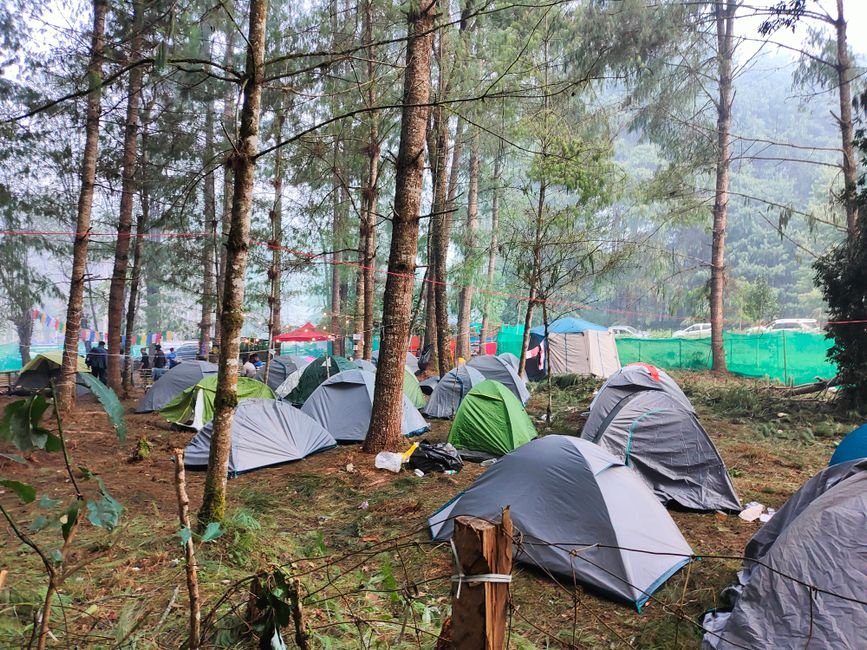
I pulled in around four on a Friday, late enough that the good loops were picked over and early enough that I could still walk around without a headlamp. The host had three sites left circled in pencil on a paper map. I parked the truck by the water spigot, poured what was left of the thermos into a cup, and walked all three of them before I unloaded a single thing.
That twenty minutes on foot is the most useful twenty minutes of my whole weekend, and for the first two or three years of doing this I skipped it entirely. Somebody handed me a number, I drove to the number, I set the tent up in the flattest looking rectangle I could see, and whatever happened after that was luck. Sometimes the luck was fine. The nights it was not fine are the ones I remember.
The first lap on foot
Walking is different from driving past. From the driver’s seat everything looks level, because you are looking down at it from four feet up and moving. On foot you feel the tilt in your ankles. You notice that the ground by the fire ring is packed hard and the ground behind it is soft and loose, which usually means water has moved through there recently.
I walk the whole site, not just the pad. I stand where I think the tent will go and turn a full circle. I look up. I look at where the neighboring site’s picnic table faces, because that tells me which direction their evening will point. Then I walk to the next candidate and do it again. It takes a few minutes each and it costs nothing, which is the whole argument for it.
Where the tent actually goes
Most sites have one honest tent spot and two spots that look like tent spots. The honest one is usually smaller than you want and slightly off center from where the gravel pad sits, because the pad was built for a trailer and the tent area was whatever was left.
I test it with my feet before I trust it. I stand on the spot, shift my weight heel to toe, then lie down on it if I am unsure. Lying down is the part people skip and it settles the argument instantly. A grade you cannot feel standing up will move you across the pad by two in the morning. If I have to sleep on a slope I would rather have my head uphill and the slope running along my body than across it, because rolling sideways into the tent wall all night is worse than sliding a few inches down.
I also check what is under the surface. Two fingers into the dirt tells me whether I am on packed clay, loose duff, or a couple inches of soft stuff over rock. Rock is not a dealbreaker. Rock I did not know about is.
Reading the traffic
Every campground has traffic and it is more predictable than it looks. There is a bathroom, there is a water tap, there is a trash area, and there is usually one loop road that everybody uses to get to the trailhead or the boat launch. Those four things generate almost all the foot traffic and headlights.
I once took a site because it was close to the restroom, which I thought was a convenience. It is a convenience for about ninety seconds a day and an inconvenience for the other twenty three hours. Doors slam. Flashlights swing across the tent wall. People stand outside talking at eleven at night because that is where the light is. Now I want to be close enough to walk there in the dark without thinking, and far enough that I cannot hear the door.
The trash area is the one people underestimate. Wildlife works that corner all night and the truck that empties it comes early.
Sun, shade, and the morning problem
Since the mornings are the reason I do any of this, I pick for morning first. I want the first sun of the day to land somewhere I can stand with a cup of coffee. That is a different question from wanting shade, and if you only think about shade you will end up in a dark cold pocket that does not warm up until ten.
The trick is figuring out where east is when you are tired and the sky is flat gray. I check my phone compass, then I look at the trees. Moss and heavier limb growth are rough hints but not reliable ones. Better is to look at where the light is coming from at that moment and do the arithmetic from the time of day.
What I want in warm months is shade over the tent by mid morning and open sky over the table at dawn. In spring I want the opposite, sun on the tent early so the condensation burns off the fly while I make breakfast.
The site I took anyway
Out of the three that Friday, one was flat and open with a great view down the drainage, one was tucked back into the trees, and one was a slightly awkward shape with a fire ring set too close to the road.
I took the awkward one. The flat open site sat about a foot lower than everything around it and the grass in it was noticeably greener, which is the ground telling you where water goes. The tucked in one had a big leaning limb over the only real tent spot. The awkward site had a fire ring in a dumb place and a tent area that sloped a little to the left, and neither of those things wakes you up at three in the morning.
That is more or less my whole approach now. I do not look for the best site. I look for the site with the flaws I can live with, and I would rather have a flaw I can see from the parking spot than a flaw that only shows up in the dark.
My short walk through list
I run the same five checks every time, in the same order, because I am not clever at the end of a drive.
First, does water want to come here. Look for the low corner, the greener grass, the sand fan where runoff spread out. Second, is there a real flat spot big enough for the tent, confirmed by lying on it. Third, what is directly overhead, dead limbs, heavy pine that drips for an hour after rain stops, anything I would not want landing on me. Fourth, where is the noise, bathroom, water tap, trash, main road. Fifth, where does the morning sun land.
Nothing on that list requires gear or experience. It requires getting out of the truck before you commit, which is the only habit here that actually matters. The rest of the weekend gets easier from there.