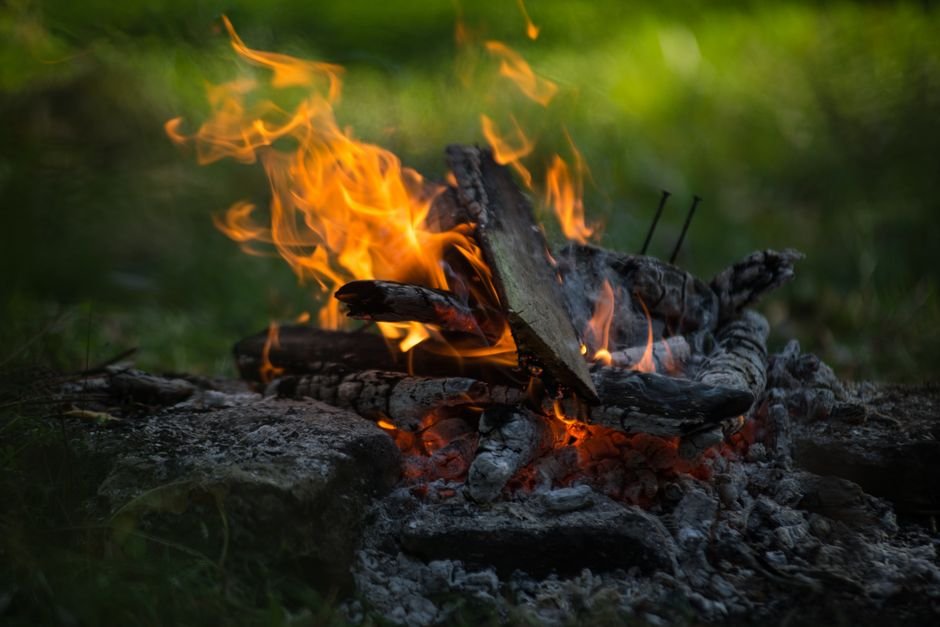
There is a photo from an early trip where I am standing next to a fire that comes up past my waist. My face is orange, everything behind me is black, and I am clearly very pleased with myself. I remember that evening as a good one. I also remember that we all ended up sitting about eight feet back from the ring, that dinner got cooked badly, and that we burned through everything we had brought by nine thirty.
I built fires like that for about three years. Not because anyone told me to. It just seemed like the fire was the point, and a bigger one was more of the point.
What a big fire actually costs
The first cost is that you cannot sit near it. A fire big enough to be impressive pushes everybody back to the edge of the light, and once you are eight feet away in forty degree weather your back is cold and your face is hot and you are not comfortable at all. The whole reason to sit around a fire is to sit around it.
The second cost is that you cannot cook on it. Flames are the wrong heat. I explained this to myself for years as bad luck with pans, when what was happening was that I was putting a skillet over the tips of a large flame and getting a scorched bottom, a raw middle, and a layer of soot on everything. There is no technique that fixes a fire that is too big.
The third is fuel. A big fire is a wood eating machine. On one trip I burned four bundles in an evening. That is a real amount of money, and more to the point it meant repeated trips to the camp host and a fire that had to be constantly fed rather than left alone.
The fourth is that it throws sparks and embers a lot farther than a small one, which matters more than the other three combined and is the one I thought about least at the time.
The evening it clicked
What actually changed my mind was not a lecture. It was a couple two sites over on a cold weekend in the fall.
They had a fire about the size of a dinner plate. Four or five pieces of wood, and it stayed that size the entire evening. They were sitting maybe two feet from it with their boots almost in the ring, close enough to talk quietly. They cooked something in a pan on a grate over it. When I walked past to the water spigot around nine they were still there and it was still the same size.
I had been thinking of a small fire as a failed big fire. Watching that, I understood it was a deliberate thing, and that they were having a better evening than I was having sixty feet away with a bonfire and a cold back.
Learning to build small on purpose
It turned out to be harder than I expected, because a small fire needs more attention, not less. A big fire has so much thermal mass that it stays lit through neglect. A small one goes out if you ignore it for twenty minutes.
What I do now is build up rather than pile on. I start the same way I always did, tinder and thin kindling in a lean to, but I stop adding fuel much earlier. Once there is a decent flame I add one piece at a time and wait to see what it does before I add another. If the fire is bigger than I want, I do nothing and let it come down.
The size I actually want
For cooking, I want no visible flame at all by the time the pan goes on. A bed of coals a couple of inches deep, raked flat, gray on the outside with orange underneath when I fan it. That is a controllable heat and it does not blacken everything.
For sitting around afterward, I want something roughly the size of a dinner plate with low flame. Enough light to see faces. Enough heat that you can sit close with your hands out. Small enough that it does not need feeding more than every fifteen or twenty minutes.
Three or four pieces of wood at a time, not eight. In an evening now I burn maybe one bundle instead of three or four, and I have found that the fire holds my attention better rather than worse. A big fire is a spectacle you watch. A small one is something you tend, and tending it is half of what I am there for.
Safety got easier, not harder
I want to be careful about how I put this, because I do not want to make it sound like a small fire is automatically a safe one. But everything I do to be responsible with a fire got easier when the fire got smaller.
It stays inside the provided ring without effort, so nothing is sitting at the edge waiting to roll out. It throws far fewer embers, which matters a great deal on a breezy night. It burns down to almost nothing on its own if I stop feeding it an hour before bed, so putting it out is a ten minute job with the water jug rather than a fight. And there is much less unburned material left in the ring in the morning.
The parts that do not change are the parts that never should. I read what is posted at the entrance every single trip, because restrictions vary by season and by conditions and are not the same as they were last time. If fires are not permitted, I cook on the stove and that is the end of it, no matter how good the evening would have been. And I put it out completely, with water, stirred, until it is silent and cold to the back of my hand.
Three years is a long time for this
What took me so long, I think, is that nothing about a big fire tells you it is wrong. It works. It is warm. It looks like what a campfire is supposed to look like. Nobody stops you.
The costs were all things I blamed on something else. Bad cooking, cold backs, running out of wood, going to bed earlier than I meant to. It never occurred to me that one decision made at seven in the evening was causing all of it.
Now I build something I would have thought was pathetic five years ago, and the evenings are longer and better. I sit close. Dinner comes out right. The wood I brought lasts. And around ten it is down to a handful of coals with almost no effort from me, which is exactly where I want it to be.