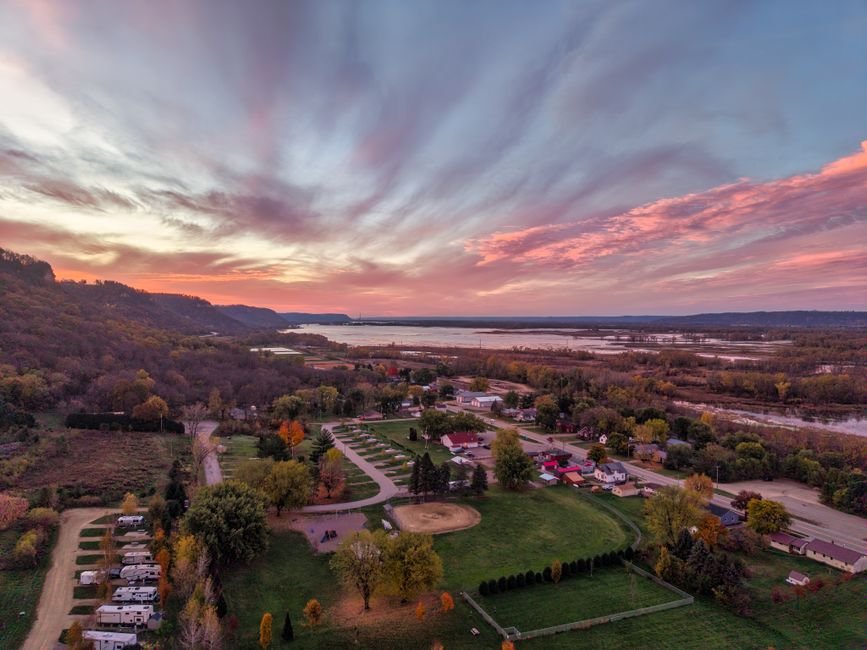
I pulled into a lakeside campground on a Friday afternoon in early November and drove the entire loop twice before I picked a site, which is not something you get to do in July. Nineteen numbered sites. One truck, parked at the far end, with nobody visible around it. The self pay station had a stack of envelopes and a pen on a string, and the camp host’s spot was empty because the host had gone home for the season six weeks earlier.
I took the site with the best view of the water, the one that is booked out for every summer weekend by February, and I paid the same amount I would have paid for the worst site in the loop in August.
What Summer Actually Costs You
I did most of my camping in the warm months for years and I did not really question it. That is when you go. That is when the weather is good.
But the summer version of this involves a booking window I have to set a calendar reminder for, a site chosen from a map by whichever rectangle was still clickable, neighbors on both sides close enough that I can follow their entire conversation, a generator somewhere in the loop, and a decent chance somebody’s speaker is going until eleven. Plus the drive, because everyone else is also driving there on Friday afternoon.
You accept all of that because that is the deal. Then you go once in the shoulder season and realize the deal was optional.
What Changes When Nobody Is There
The obvious thing is the noise, or the absence of it. On that November night I could hear the lake, which I had been to four times in summer and had never once heard.
But the part that surprised me more was how differently I used the place. In summer I stay in my rectangle because everybody’s rectangle is occupied and there is an unspoken agreement about it. With an empty loop I wandered. I walked the shoreline at dusk without passing anyone. I sat by the fire until late without wondering if I was the guy keeping someone awake. I used the picnic table at the next site over because it had better light.
Wildlife behaves differently too. Deer came through the loop at dusk and did not particularly care about me. In August that same area is a parking lot of coolers and camp chairs and nothing wild comes near it.
And the light in the fall and winter is better than summer light by a wide margin. The sun stays low, the trees are bare or turning, the mornings have frost on them, and everything looks like it is being photographed by someone competent.
The Nights Are The Price
I am not going to pretend the cold is a bonus. It is the cost, and it is a real cost. My first few off season trips were rough and I have written elsewhere about the night that taught me most of what I know, which involved me sitting in my car at five in the morning waiting for the sun.
What I would say is that the cold is a solvable problem in a way that a crowded campground is not. Nobody can fix the family with the speaker at site fourteen. But being cold at night is mostly about what is under you, whether you got in the bag warm, and whether you are sleeping in clothes you sweated in all day. Those are all things I control, and once I sorted them out the off season stopped feeling like an endurance exercise.
It took me about four bad nights to get to a point where cold weather trips are just trips. That is a low price for having the good sites available whenever I want them.
What You Give Up
Being honest about the tradeoffs, because it is not all upside.
Water gets shut off. Most of the campgrounds I go to turn off the spigots and close the flush toilets sometime in the fall, leaving a vault toilet and nothing else. So I bring all my own water, which for drive up camping is trivial but you have to remember it.
Some loops close entirely, or the whole campground goes to a smaller winter loop, or the gate is closed and you park outside and walk in. Camp hosts leave. Nobody is coming to help you if something goes wrong, which matters more if the road in is unpaved.
Daylight gets short. Getting there at four in the afternoon can mean setting up in the dark, so I leave earlier than I would in summer. And a rainy cold trip is meaningfully worse than a rainy warm trip, so I pay much closer attention to the forecast than I used to.
How I Book It Now
Mostly I do not book it. That is the point. A lot of these places switch to first come first served once the season ends, and the ones that still take reservations have everything available three days out.
What I do instead is check the campground’s own page for closure dates and water shutoff, which is usually buried and rarely on the reservation site. I call the ranger station if it is not clear, because they will tell you exactly what is open and what the road is like, and they are noticeably more willing to talk in November than in July.
I also have three or four places within about two hours of home that I have now been to in every season, and knowing a place across the whole year is its own reward. The site I took that November night is the same site I have sat at in August surrounded by people. It did not feel like the same campground at all.
The Trade I Keep Making
One rough night of sleep, occasionally, in exchange for a lake I can actually hear, a site I did not have to compete for, and mornings with frost on the table and nobody else awake.
I make that trade every time now. The cold was never the point. It is just what stands between me and an empty loop, and it turns out to be a much smaller obstacle than it looked from the middle of July.