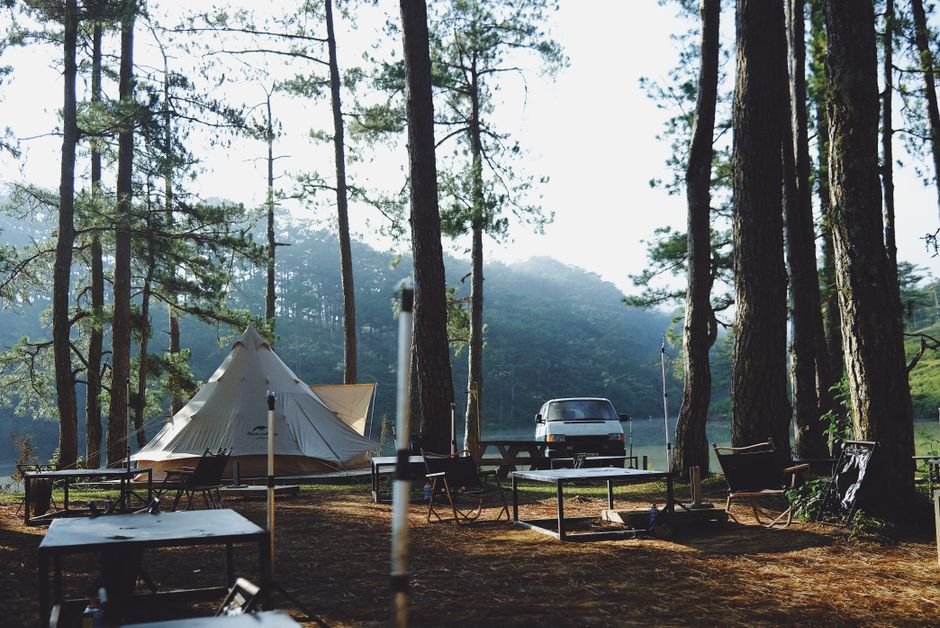
I got the site everybody wants. It sat right on the edge above the water, no trees between me and the whole opening view, the kind of spot people slow down to look at when they drive past. I remember standing there with my hands on my hips feeling like I had won something.
Then the wind came up around eight at night and did not stop until sometime the next afternoon. The fly cracked like a flag. I could not keep a stove lit long enough to make anything. Every person in the loop walked to the edge of my site to take a picture, because it was the view and they were not going to skip it, and I sat in a chair being scenery.
Views come with weather attached
The reason a site has an open view is that there is nothing in the way, and the thing that would normally be in the way is also the thing that blocks wind. An exposed site above water or on a rim or at the edge of a meadow is exposed in every sense at once.
It is windier, which affects sleep, cooking, and whether a fire is pleasant or a hazard. It is colder at night, because there is no canopy holding heat in and open ground radiates. It gets full sun with no relief, which in summer turns a tent into an oven by nine in the morning. And when weather comes through, it comes through your site first.
None of that shows up when you are looking at the view at four in the afternoon in nice conditions. That is the trap. You evaluate the site at its best moment.
You do not look at the view as much as you think
This is the part that surprised me. Over a two night trip I am at the site for maybe fourteen waking hours. A good chunk of that I am doing something with my hands, cooking, sorting gear, reading, tending the fire, and my eyes are on the task.
The view gets maybe an hour of real attention, mostly in the first twenty minutes and at sunset. After that it becomes the background, the way a nice painting in your house becomes the wall.
Meanwhile the things I interact with constantly are the ground under the tent, the table, the distance to water, the fire ring, whether there is a flat rock to put a pot on, and whether I can hear my neighbors. Those are the actual furniture of the weekend and none of them photograph well.
What a site with good bones has
When I look at sites now, I am looking for a set of unglamorous things.
Real separation from the neighbors, meaning vegetation or a rise or distance, not just a line on the ground. A tent area that is flat, drains, and is not directly under anything heavy. A table that is level enough to cook on and positioned somewhere useful rather than in the middle of the traffic path. A fire ring far enough from the tent that a spark is not an event and close enough to the seating that you are not shouting across the site.
Then the small ones. Somewhere to hang a line in the sun. A tree or a post to lean things against. A spot where the morning light lands that is not also the spot where the wind comes from. Water within a short walk but not so close that everybody’s route passes your door.
A site with all of that and no view at all will give you a better weekend than an outlook with none of it.
The site I keep thinking about
The best site I have had in the past couple of years was in the back corner of a loop, in the trees, with a view of nothing but more trees. It was slightly awkward to back into. It had a fire ring that somebody had rebuilt out of the original stones with a flat one set into the side at exactly the right height for a coffee pot.
The tent went on a slightly raised bed of duff that had clearly been used a hundred times before. The trees were high enough that I got shade from ten onward and there was a gap on the east side where the sun came through around seven and lit the table. Nobody walked past because it was the last site and there was nowhere to walk to.
I do not have a single good photograph from that weekend. I slept nine hours both nights.
How to spot a good site from the road
Since these sites do not announce themselves, I look for a few markers when I am walking the loop.
Dead end and corner sites, because there is no through traffic. Sites on the outside of a curve, which usually have more depth behind them. Sites with one neighbor instead of two. Sites where the parking spur is short and slightly awkward, because those get passed over by big rigs and stay quieter.
I also look at the condition of the tent area, which tells you how a site has been used. A well worn, clearly defined, slightly raised flat area means people have chosen that spot over and over, and that collective judgment is more reliable than my twenty minute assessment.
And I look at what is behind the site rather than in front of it. A view in front is nice. A wall of brush behind is what actually makes a site feel like a room.
Where the view still wins
I am not saying take the ugly site. If the weather is settled, if it is a mild time of year, if it is one night rather than three, and if the loop is not busy enough that you will be a tourist attraction, take the view. Sitting somewhere open with coffee while the light comes up is a good enough reason to accept a windy night.
But I now treat the view as a bonus on top of a site that already works, not as the thing that decides it. If the outlook site also has flat drained ground, some shelter, and a bit of privacy, that is the best site in the campground and I will take it happily. If it only has the view, I keep walking, and I have never once regretted that on the drive home.